Next-Generation Technical Textiles
and the critical factor
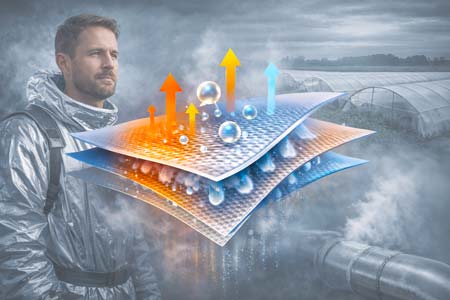
As technical textiles advance into increasingly demanding and specialised applications, accurate measurement of vapour and gas permeability has become a fundamental requirement. Versaperm’s latest modular measurement systems are now used across textile development and production in a wide range of industries where performance and reliability is critical.
As technical textile structures become more complex and are required to perform across an ever-widening range of gases and operating environments Versaperm’s mass spectroscopy-based permeability measurement systems have been developed to meet these challenges. Versaperm systems can measure the transmission rate (Vapour permeability) of multiple gases with a single measurement that delivers with accuracies reaching parts-per-million or parts-per-billion. The environment can be controlled and cycled across an extreme range of conditions, (from -80 to 1100+ C and from 0 to 300+ bar), enabling confident material development, validation and quality control.
Technical textiles are engineered primarily for function rather than appearance and are routinely deployed in environments where the controlled transmission of gases and vapours is critical. While water vapour plays a central role in apparel, medical and protective textiles, many other gases are equally important depending on the application. These include hydrogen and helium in aerospace and lighter-than-air structures, oxygen and carbon dioxide in agricultural and environmental systems, medical gases in healthcare applications and petroleum-based vapours in automotive and industrial sectors.
In wearable and protective applications inadequate permeability control can result in wearer fatigue, reduced productivity, skin irritation and increased microbial growth. In non-apparel technical textiles such as airship envelopes, agricultural solarisation films, medical devices and vapour or fuel barriers, incorrect gas transmission rates can lead to performance failure, safety risks or reduced system efficiency. In multilayer and membrane-based constructions, uncontrolled gas or vapour movement causes internal condensation, material degradation and long-term loss of barrier integrity. Accurate permeability measurement allows these risks to be identified, quantified and addressed early in the development process rather than after deployment in real-world conditions.
ENDS
Please send any sales enquiries to
Versaperm Ltd: 10 Rawcliffe House, Howarth Road, Maidenhead, Berkshire, SL6 1AP, UK,
e.mail: info@versaperm.com Web: www.versaperm.com
UK Tel: +44 (01628) 777668
USA Tel +1 (617) 855-7477
For Further Press Information please contact:
Gerry Palmer @ the Palmer & Rose Partnership
Tel +44 (0) 1494 637499
e.mail gerry@palmer-rose.co.uk

 We welcome questions and comments about our products and services, you can reach us as follows: